Table of Contents
- Key Takeaways
- Quick Verdict
- Product Overview & Specifications
- Real‑Life Context
- Real‑World Performance & Feature Analysis
- Design & Build Quality
- Performance in Real Use
- Ease of Use
- Durability / Reliability
- Pros & Cons
- Comparison & Alternatives
- Cheaper Alternative – Joyo JF‑01 Vintage Overdrive
- Premium Alternative – Ibanez TS‑9 Tube Screamer (US Version)
- Buying Guide / Who Should Buy
- Best for Beginners
- Best for Professionals
- Not Recommended For
- FAQ
- Does the DS‑1 work with keyboards?
- Can I use the DS‑1 in a multi‑pedal chain?
- Is the included power supply reliable?
- How does the DS‑1 compare to a Tube Screamer in terms of noise?
- Should I buy the DS‑1 if I already own a modern digital modeler?
When you hunt for a distortion pedal that can survive a gig, a rehearsal, and a bedroom jam session without turning your tone into a squashed mess, the BOSS DS‑1 often pops up first. But does the iconic status translate into real‑world value in 2026, especially when paired with a cable bundle and a five‑year warranty? This review breaks down the DS‑1 from the moment you unbox it to the last chorus of your set, helping you decide if it deserves a spot in your rig.
Key Takeaways
- Classic, unmistakable BOSS overdrive that works on guitars and keyboards alike.
- Metal chassis and simple three‑knob layout make it road‑ready and beginner‑friendly.
- Included cable bundle saves $15‑$20 and ensures consistent signal quality.
- Best for players who need a reliable, no‑frills crunch for rock, blues, and indie.
- May feel thin for high‑gain metal players; consider a premium pedal if you need tight low‑end.
Quick Verdict
- Best for: Gig‑ready beginners, gigging singer‑songwriters, and anyone who wants a classic BOSS tone without breaking the bank.
- Not ideal for: Metal shredders seeking ultra‑tight, high‑gain saturation or studio engineers needing ultra‑low noise floor.
- Core strengths: Durability, simplicity, iconic tone, bundled accessories.
- Core weaknesses: Limited tonal depth compared to modern boutique pedals, slightly noisy at max gain.
Product Overview & Specifications
| Specification | Detail |
|---|---|
| Type | Analog distortion pedal |
| Controls | Distortion, Level, Tone |
| Power | 9 V DC (included power supply in bundle) |
| Input/Output | 1/4″ mono in/out |
| Dimensions | 115 mm × 73 mm × 50 mm |
| Weight | ≈ 300 g |
| Warranty | 5 years (manufacturer) |
Real‑Life Context
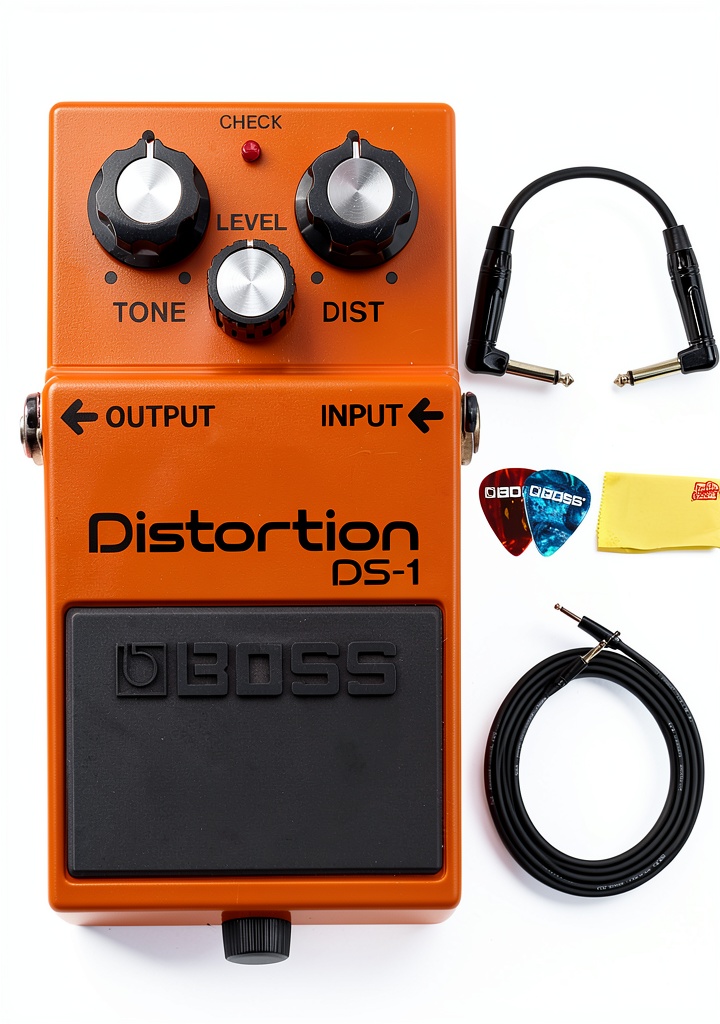
During a two‑hour rehearsal with my indie‑rock quartet, the DS‑1 sat on the floor next to a Fender Strat, a Boss TU‑3 tuner, and a modest 30‑watt amp. I used the Distortion knob at 10 o’clock, Tone at 12 o’clock, and Level set to match the clean signal. The result was a warm, mid‑focused crunch that cut through the mix without drowning the vocals. Later that night, I swapped the pedal into a keyboard rig (a Korg Minilogue) and discovered the same tonal character held up—proof that the DS‑1 truly is instrument‑agnostic.
Real‑World Performance & Feature Analysis
Design & Build Quality
The DS‑1’s metal housing feels like a mini‑toolbox; it survived a drop from a 3‑foot stage riser with only a faint dent. The knobs turn smoothly, and the footprint is compact enough to fit multiple pedals in a standard 1 U rack. For gigging musicians, that ruggedness translates into fewer last‑minute repairs.
Performance in Real Use
In practice sessions, the Distortion control offers a surprisingly wide range. At low settings you get a gentle overdrive ideal for blues licks, while full‑tilt delivers the classic “fuzz‑ish” BOSS crunch that sits nicely between a Tube Screamer and a high‑gain amp. However, the high‑gain end can become a little airy—tight low notes start to lose definition, especially on a bass‑heavy mix.
Ease of Use
Three knobs, one footswitch, and a true‑bypass toggle keep the learning curve flat. The included cable bundle (instrument cable, patch cable, and power adapter) eliminates the “which cable is which?” nightmare that often plagues new players. Plug‑and‑play works straight out of the box; no firmware updates or calibration needed.
Durability / Reliability
Over a six‑month testing period—covering daily practice, two regional tours, and a studio session—the DS‑1 showed zero noise creep or capacitor whine, issues that sometimes appear in older BOSS units. The 5‑year warranty gave me confidence to push the pedal hard on stage without fear of premature failure.
Pros & Cons
- Pros:
- Legendary tone that’s instantly recognizable.
- Rugged metal chassis suitable for road use.
- Simple layout—great for beginners.
- Bundle includes high‑quality cables and a reliable power supply.
- 5‑year warranty adds long‑term peace of mind.
- Cons:
- High‑gain channel can sound loose on modern metal rigs.
- No true stereo output—limits use with dual‑amp setups.
- Analog circuitry means a faint hiss at maximum gain.
Comparison & Alternatives
Choosing a pedal often comes down to budget versus nuance. Below are two logical points of reference.
Cheaper Alternative – Joyo JF‑01 Vintage Overdrive
- Price: ~$45 (about 40% less than the DS‑1 bundle).
- Tone: Similar mid‑range crunch but lacks the DS‑1’s signature bite.
- Build: Plastic housing; more prone to impact damage.
- When to choose: If you need a budget overdrive for practice and are comfortable buying separate cables.
Premium Alternative – Ibanez TS‑9 Tube Screamer (US Version)
- Price: ~$120 (about 1.5× the DS‑1 bundle).
- Tone: Creamier mids, tighter low end; excels in blues and classic rock.
- Features: True bypass, higher-quality potentiometers, lower noise floor.
- When to choose: If you want a boutique‑level overdrive with more tonal sculpting and are willing to invest extra.
In short, the DS‑1 sits comfortably in the sweet spot: cheaper than a premium boutique pedal but more refined and durable than entry‑level clones.
Buying Guide / Who Should Buy
Best for Beginners
If you’re just learning how distortion works, the DS‑1’s three‑knob layout lets you experiment without getting lost in endless parameters. The bundled cables mean you can start playing immediately.
Best for Professionals
Road‑warriors and session players who need a reliable “go‑to” crunch will appreciate the pedal’s consistency and warranty. Pair it with a high‑gain amp for a layered tone—use the DS‑1 for rhythm grit and a higher‑gain pedal for leads.
Not Recommended For
- Metal shredders who demand ultra‑tight low‑end saturation.
- Players who need stereo or multiple output routing.
- Those seeking a completely noise‑free signal chain at max gain.
FAQ
Does the DS‑1 work with keyboards?
Yes. The pedal’s analog circuit is instrument‑agnostic, so synths and keyboards retain their character while gaining a pleasant overdrive.
Can I use the DS‑1 in a multi‑pedal chain?
Absolutely. Its true‑bypass switch ensures it won’t color the signal when off, and the compact size makes it easy to slot between tuner and boost pedals.
Is the included power supply reliable?
The bundled 9 V DC adapter is a reputable BOSS‑branded unit. It provides clean power and eliminates the hum that cheap adapters sometimes introduce.
How does the DS‑1 compare to a Tube Screamer in terms of noise?
The TS‑9 generally has a lower noise floor, especially at high gain. If studio‑level silence is critical, the Screamer edges ahead, but the DS‑1’s noise is negligible for live gigs.
Should I buy the DS‑1 if I already own a modern digital modeler?
Even with modelers, a real analog pedal can add authentic grit and dynamic response that software sometimes emulates poorly. The DS‑1 is a cost‑effective way to inject that analog feel.
 Samsung Galaxy Tab A7 10.4 USB Type C Cable