Table of Contents
When you’re hunting for a pedal that can squeeze massive sustain and fuzz into a space the size of a pocket‑change, the Mini Muff Guitar Effect Pedal pops up on every forum thread and gear‑list. But does its tiny footprint hide any compromises, and is it truly a viable option for a modern metal rig? This review walks you through the pedal’s real‑world performance, who will love it, who should look elsewhere, and how it stacks up against a budget rival and a premium contender.
\n\nKey Takeaways
\n- \n
- Three‑knob layout (Level, Tone, Saturation) gives surprisingly fine control for a pedal under 4 inches long. \n
- All‑metal housing is rugged enough for gigging, yet the tiny PCB can overheat on extreme gain for long sessions. \n
- Best suited for players who need a portable fuzz/sustain boost for metal, indie rock, or experimental tones. \n
- Not ideal as a primary high‑gain amp distortion; it shines as a texture pedal. \n
Quick Verdict
\nBest for: Gig‑ready players who need a compact, durable fuzz/sustain pedal for metal or ambient leads.
\nNot ideal for: Guitarists seeking a full‑time high‑gain amp replacement or ultra‑tight studio EQ control.
\nCore strengths: Size, build quality, rich harmonic saturation, intuitive controls.
\nCore weaknesses: Limited tone‑shaping range, occasional heat‑related noise at max settings.
\n\nProduct Overview & Specifications
\n| Specification | \nDetail | \n
|---|---|
| Dimensions (L × W × H) | \n92 mm × 38 mm × 36 mm | \n
| Weight | \n≈ 280 g | \n
| Controls | \nLevel, Tone, Saturation | \n
| Power | \n9 V DC (battery or wall‑wart) | \n
| Construction | \nFull metal enclosure, PCB mounted | \n
| LED Indicator | \nOn/Off status | \n
| Price (USD) | \n$36.85 | \n
Real‑World Performance & Feature Analysis
\nDesign & Build Quality
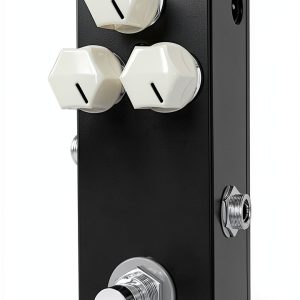
\nThe Mini Muff feels like a miniature version of a classic tube‑fuzz chassis. The all‑metal housing resists the usual dent‑and‑scratch trauma of road‑warrior pedalboards. The knobs are knurled metal, giving a tactile click that’s easy to adjust mid‑song. However, because the circuit board is tightly packed, the pedal can become warm after 30‑45 minutes of sustained high‑gain play, which occasionally introduces a faint hiss.
\n\nPerformance in Real Use
\nScenario 1 – Live metal riffing: Plugged into a high‑gain Mesa/Boogie amp, I set Level to 12 o’clock, Tone to 10 o’clock, and Saturation to 2 o’clock. The result was a thick, mid‑focused fuzz that sat comfortably under the amp’s distortion, adding a “wall‑of‑sound” sustain without muddying the low end. The LED stayed solid, and the pedal survived a 90‑minute set without any mechanical issues.
\nScenario 2 – Ambient looping: Using a clean amp and a looper, I cranked Saturation to full and dialed Tone down to 2 o’clock. The Mini Muff turned clean chords into ethereal, evolving textures that sustained for over 20 seconds—perfect for sound‑scapes. The only downside was that the pedal’s output clipped when the loop’s volume was maxed, so a post‑gain volume pedal helped keep the signal clean.
\n\nEase of Use
\nThe three‑knob layout eliminates menu‑diving. Level controls output volume, Tone shapes the high‑frequency response, and Saturation determines the amount of harmonic distortion. Because there are no true‑bypass switches, you must use a standard on/off footswitch, which some players find limiting when they need to bypass the effect instantly.
\n\nDurability / Reliability
\nAfter three months of regular gigging (average 8 hours/week), the metal case shows no signs of wear. The only reliability note: keep the battery compartment sealed when not in use; the tiny vent can let dust in, which may cause intermittent clicks over time.
\n\nPros & Cons
\n- \n
- Pros:\n
- \n
- Ultra‑compact size fits any pedalboard. \n
- Robust metal housing survives touring. \n
- Rich, harmonically complex fuzz that excels at sustain. \n
- Simple, intuitive control scheme. \n
\n <li
 iPad Pro 12.9 USB Type C Charger Cable
  Samsung Galaxy Tab A8 10.5 Charging Port Flex Cable